

9320A SAM™ Reference Controller
Five audio tools in one – for a boosted workflow
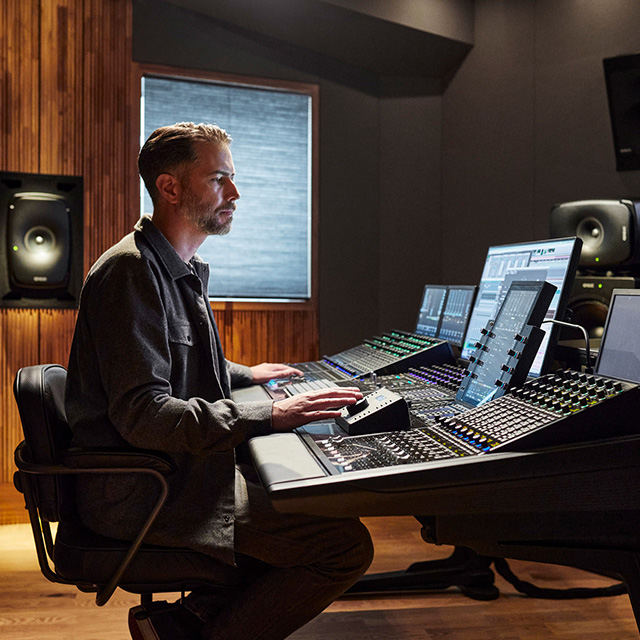
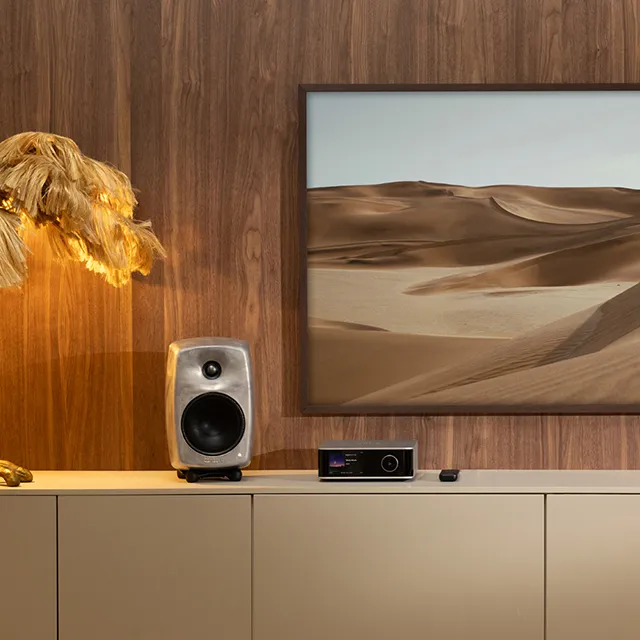
As a professional monitor controller, calibration set, output interface, GLM remote and headphone amplifier, the 9320A integrates tightly with our UNIO Ecosystem to offer audio engineers seamless bridging of in-room and personal headphone monitoring – from stereo to immersive.
And now, with UNIO Personal Reference Monitoring (PRM), the 9320A can be combined with 8550A Professional Reference Headphones for total accuracy.
9320A SAM™ Reference Controller
Five audio tools in one – for a boosted workflow
As a professional monitor controller, calibration set, output interface, GLM remote and headphone amplifier, the 9320A integrates tightly with our UNIO Ecosystem to offer audio engineers seamless bridging of in-room and personal headphone monitoring – from stereo to immersive.
And now, with UNIO Personal Reference Monitoring (PRM), the 9320A can be combined with 8550A Professional Reference Headphones for total accuracy.

Compatible avec n'importe quel système DAW et interface audio, le 9320A met à votre portée une connectivité flexible, une sortie casque de qualité référence ainsi qu'un contrôle physique de nos technologies Smart Active Monitoring (SAM), Genelec Loudspeaker Manager (GLM) et Aural ID. Vous pouvez ainsi accéder en toute confiance à votre référence de studio, où que vous soyez et à tout moment, pour créer rapidement des mixages qui se traduisent avec une cohérence optimale.



1. Every monitoring option at your fingertips
Quick control of SAM, GLM and Aural ID
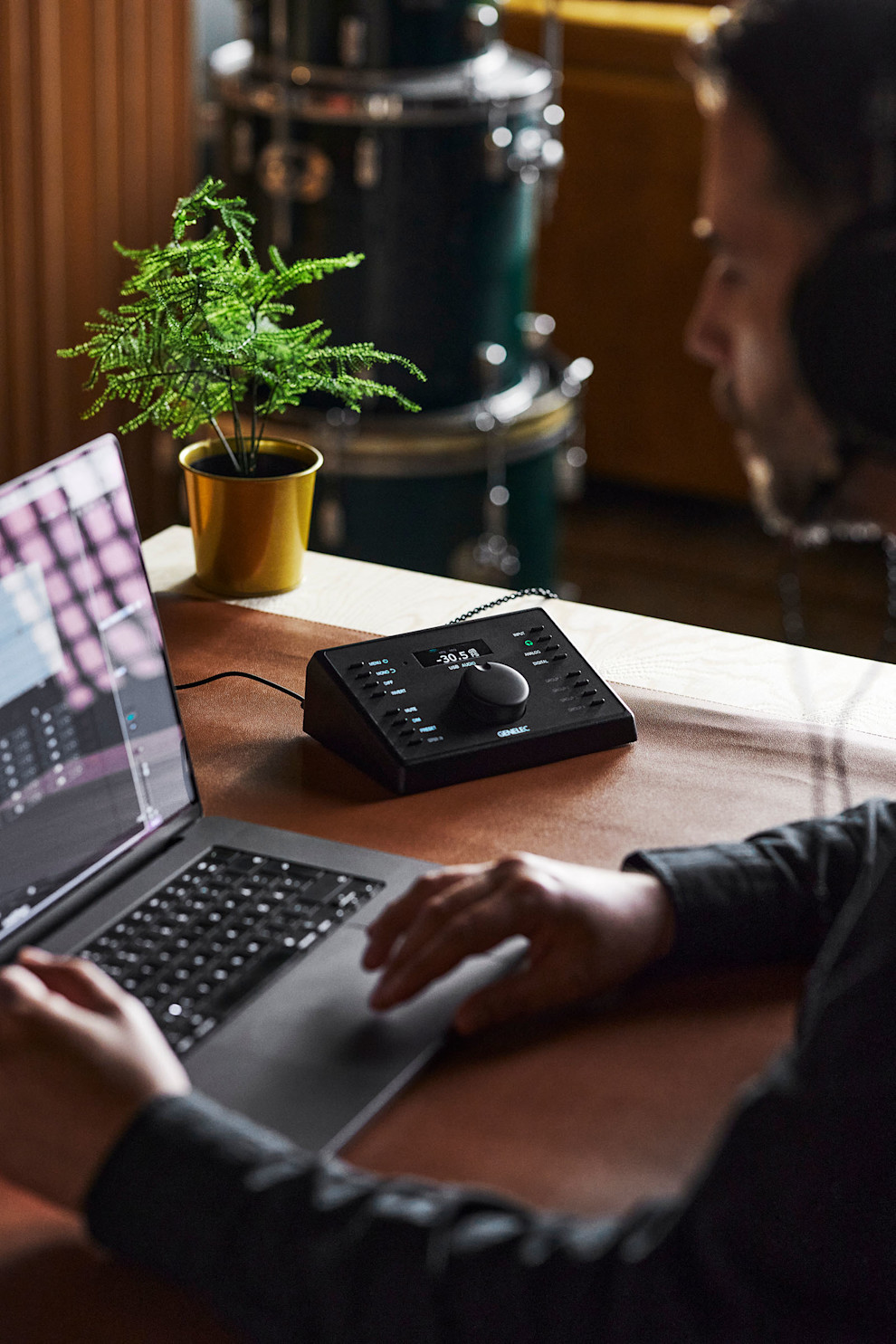
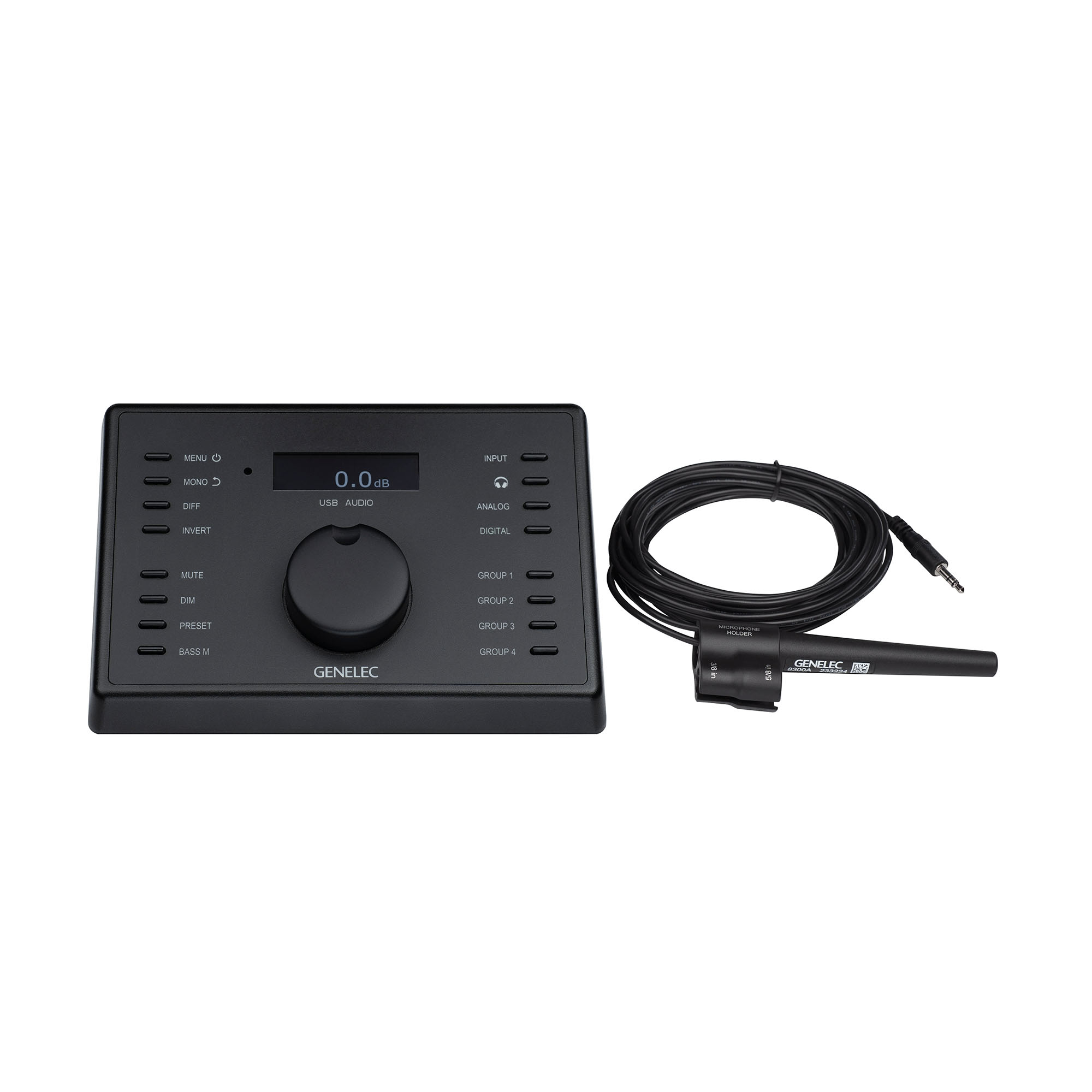
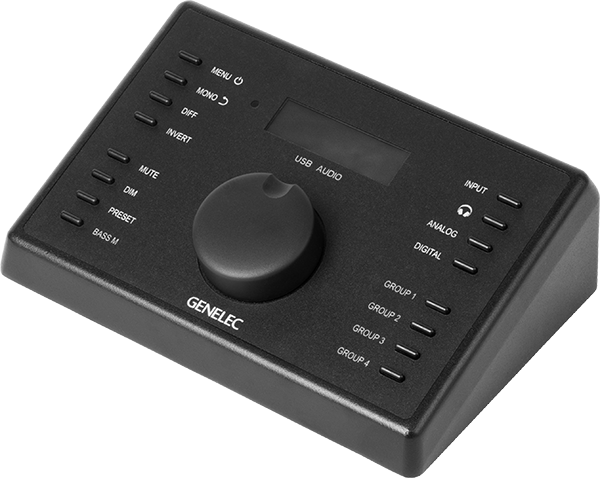
The 9320A provides intuitive and quick-to-access physical control of our SAM, GLM and Aural ID Technology – with clear haptic feedback – for a faster workflow and less need to keep software windows open. With control of GLM right at your fingertips, it’s easy to switch between and manage all your SAM Monitoring layouts, from stereo to immersive.
Easy alignment of additional in-room monitoring
Level alignment and control of any additional stereo monitoring systems connected directly to the high-quality outputs of the 9320A is simple. This enables you to move rapidly between in-room monitoring options and trust each one for reference listening.
Seamless bridging to headphones
With the 9320A, headphone monitoring can also be quickly and precisely level aligned and controlled – giving you smooth and easy button switching between all your loudspeaker and headphone-based monitoring, with no need to readjust level each time.
2. Professional headphone monitoring
Reference-grade headphone output
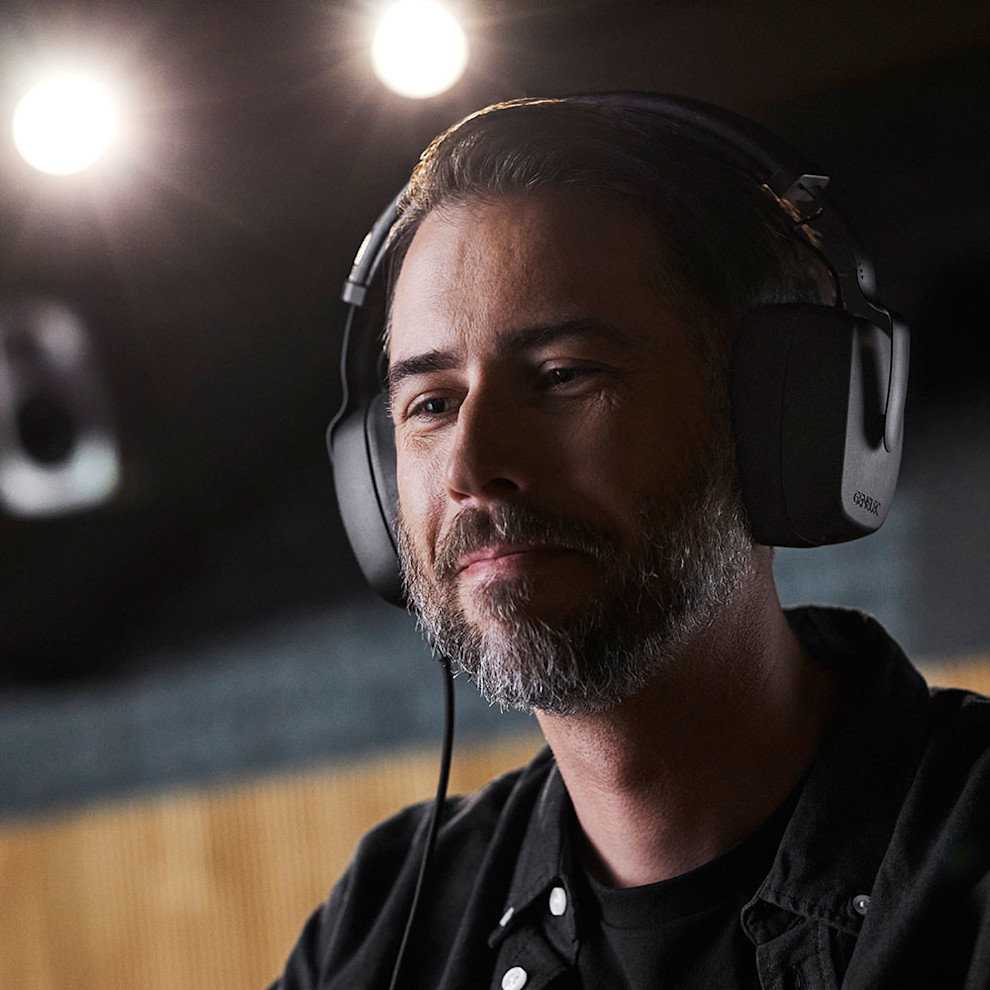
The 9320A aids reference listening by providing the tools needed to calibrate your personal headphone sound character. The headphone output supports impedances from 16 to 600 ohms with incredible linearity (THD+N less than -110 dB) and dynamic range (126 dB), and a maximum RMS output of 6 volts – to offer the best possible performance from any high-quality professional headphones.
UNIO Personal Reference Monitoring
Our UNIO PRM solution combines the 9320A with a specific factory-calibrated pair of 8550A Professional Reference Headphones, for total accuracy. This uniquely matched system represents a pioneering new active monitoring headphone solution with exceptional sonic reliability, taking seamless bridging of in-room and personal headphone monitoring to a whole new level.
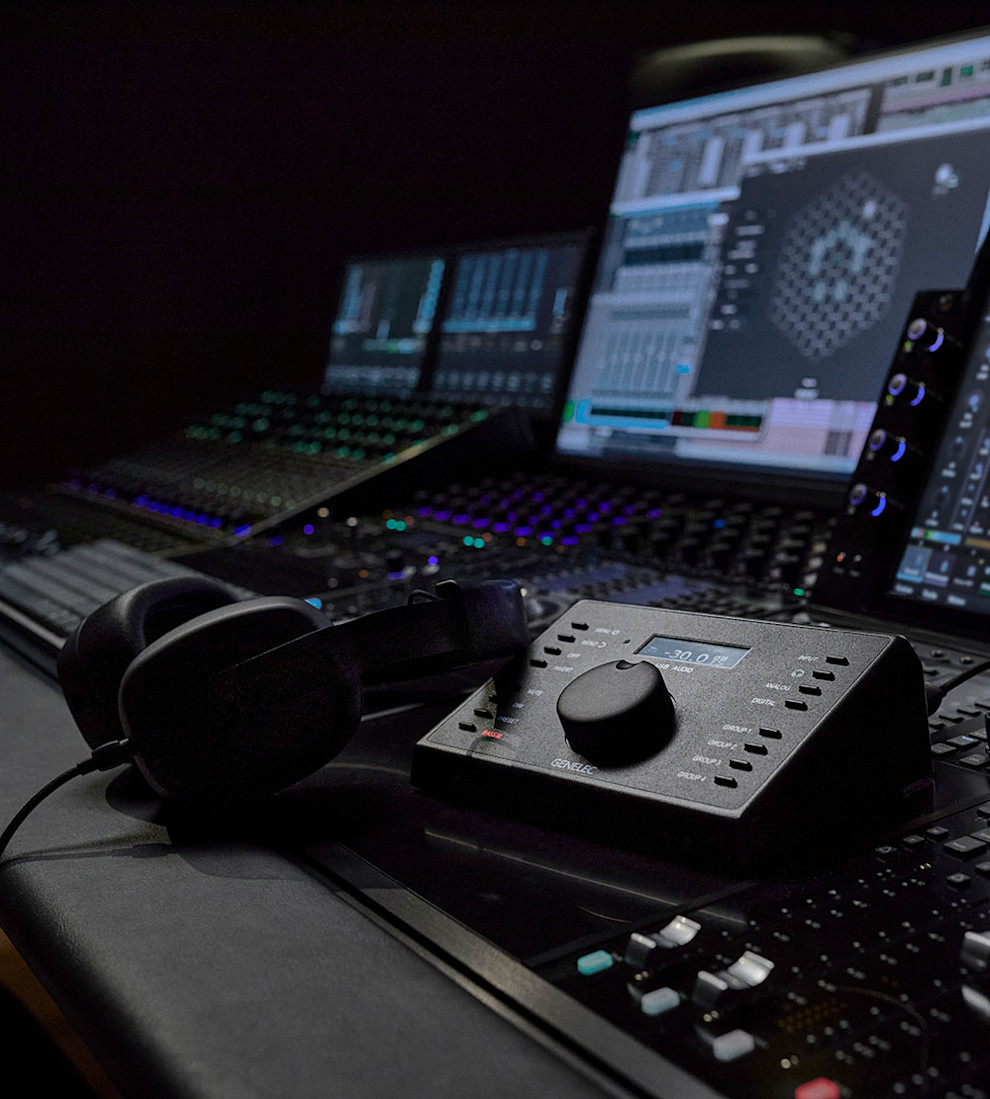
3. Software calibration and greater freedom
Automatic GLM AutoCal 2 calibration
Working with the GLM software and SAM system elements of our UNIO Ecosystem, the 9320A provides neutral, carefully aligned audio reproduction over loudspeaker monitors – with correctly calibrated and equalised subwoofer support when needed. Additionally, GLM provides access to detailed GRADE™ Room Acoustic Reports. For this, a factory-calibrated Reference Microphone is included with the 9320A.
Take your reference beyond the studio
The alignment tools offered by the 9320A enable the smoothest possible transitioning when cross referencing between loudspeaker monitoring and headphones. This gives you the benefit of being able to access a tight match to your studio reference via compact stereo monitoring systems and headphones – for the freedom to work outside your trusted base without compromising your effectiveness.
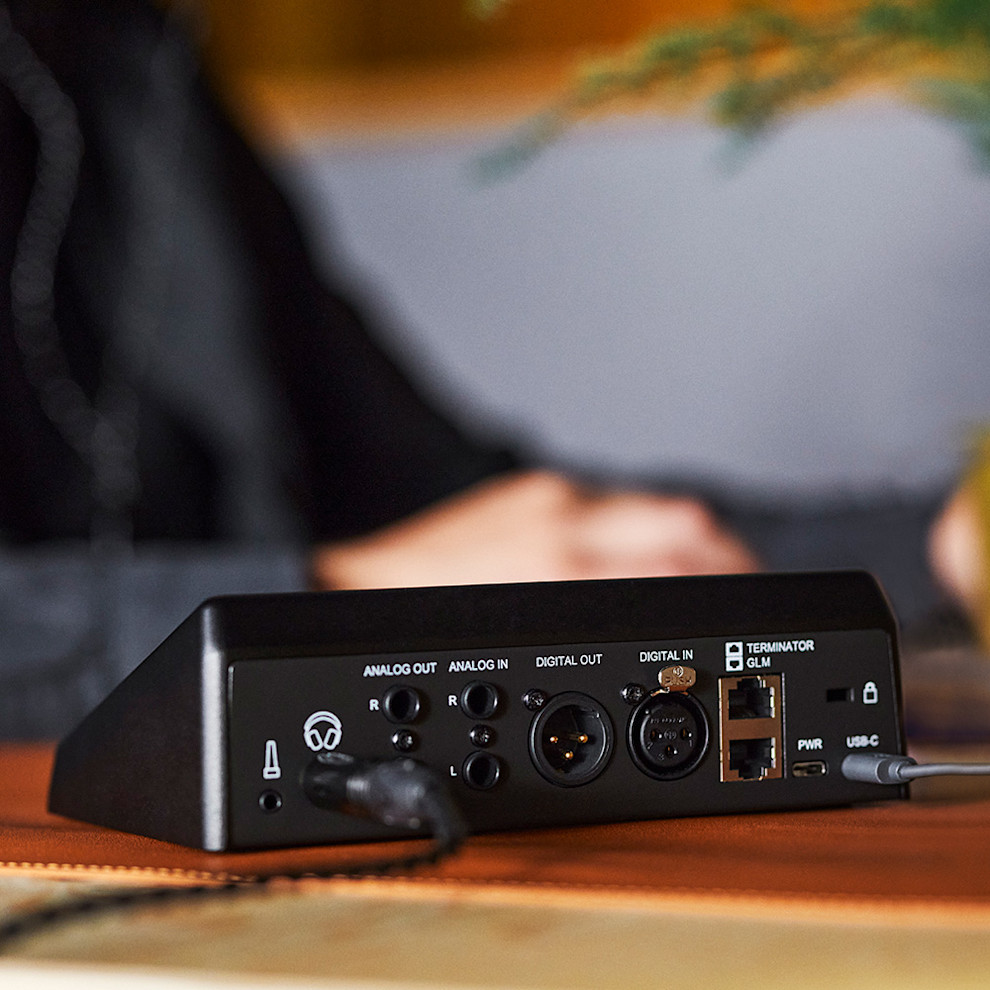
4. AES/EBU connectivity for the purest signal
Versatile monitoring options
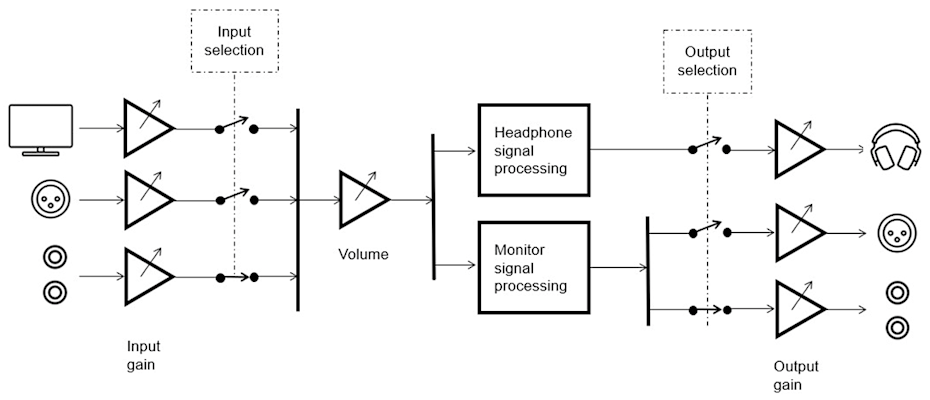
Stereo and stereo-with-subwoofer monitoring systems connect easily to the 9320A using its analogue and AES/EBU input/output connectivity. The device also works as a USB output interface for high resolution stereo audio from a computer. The balanced analogue outputs and AES output of the 9320A support both fixed line level and adjusted line signals, making it compatible with any professional loudspeaker monitor or headphone set.
High-quality DAC conversion
Use our hugely versatile 9320A as a high-quality converter from analogue to AES and AES to analogue – as well as converting USB computer audio to any output – creating an extremely effective hub for your professional monitoring tasks. The maximum level of the analogue balanced line input can be set to +12 dBu or +24 dBu, while USB and AES digital audio is routed to the AES output with an A-weighted dynamic range of 138 dB.
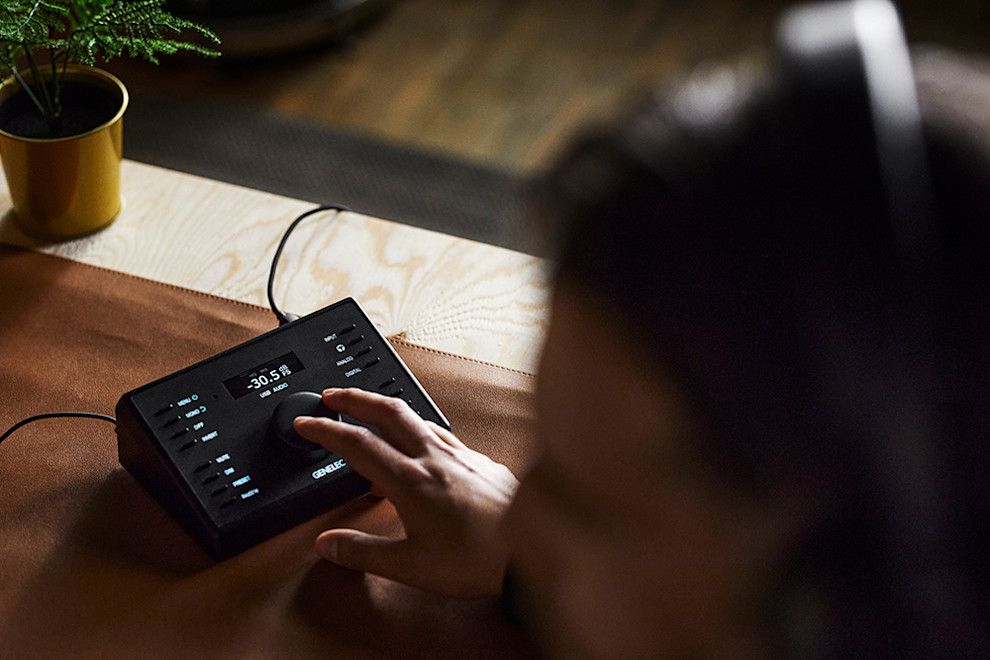
5. Safe listening via noise dose estimation
Hearing health support during monitoring
Protect your ears with the help of continuous A, C and Z weighted SPL monitoring shown on the backlit display of the 9320A, which allows quick assessment of listening safety.
SPL is sampled using the included Reference Microphone for in-room audio – and calculated using headphone sensitivity data for headphone audio. The audio engineer's sound exposure dose is logged, and dose alarms can be set with ease. Combined with the ability to create highly linear monitoring systems – which naturally support minimal hearing fatigue – these listening safety features make the 9320A a key ally for hearing preservation.
Comment utiliser le 9320A ?
Pour le monitoring professionnel en configuration fixe ou mobile
Le 9320A est l'outil de monitoring audio polyvalent par excellence pour les ingénieurs travaillant dans les domaines de la musique (stéréo et audio immersif), de l'audio pour le jeu vidéo, de la diffusion (broadcast), du streaming et de la post-production audiovisuelle.
Bien qu'il donne sa pleine mesure lorsqu'il est intégré à notre solution PRM — aux côtés d'enceintes SAM et d'un ordinateur exécutant les logiciels GLM et Aural ID —, le 9320A peut également être utilisé en mode autonome, sans ordinateur ; il prend en charge tous les types d'enceintes de monitoring et de casques professionnels.
Alimenté via sa connexion de données USB-C, le 9320A est compatible avec n'importe quelle station de travail audio numérique (DAW). Si l'ordinateur ne peut pas fournir l'alimentation nécessaire, une entrée d'alimentation USB-C dédiée permet de le relier à une source d'énergie externe.
La bande passante audio, pour toutes les combinaisons d'entrées et de sorties, s'étend jusqu'à 46 kHz ; l'appareil offre une plage dynamique supérieure à 120 dB, un taux de distorsion harmonique totale plus bruit (THD+N) inférieur à -110 dB et une latence entrée-sortie minimale comprise entre 2 et 3,2 ms.
L'application Aural ID ajoute une fonction de monitoring virtuel.
Notre flexible logiciel de monitoring virtuel binaural, Aural ID Application, offre une écoute au casque spatialement précise et sans coloration — du stéréo à l'audio immersif — tout en permettant de créer et d'utiliser votre propre profil HRTF ultra-détaillé pour une précision exceptionnelle. Le 9320A fournit une sortie casque de qualité référence, idéale pour exploiter tout le potentiel d'Aural ID Application en toute confiance.
title="Signal Flow">
UNIO Audio Monitoring Ecosystem
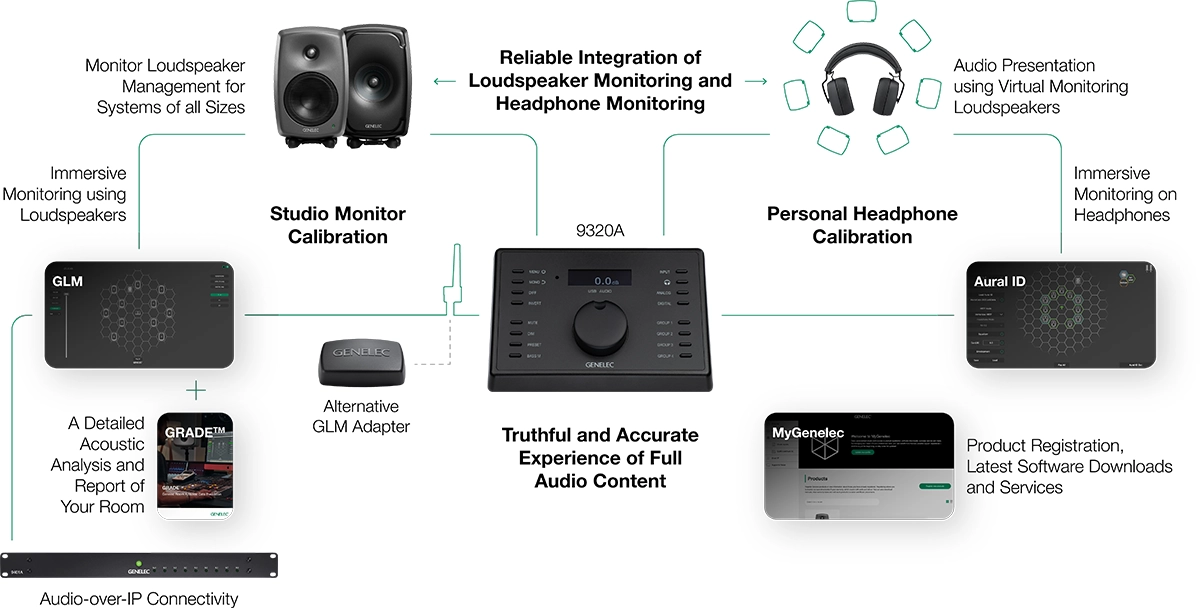
Example setups
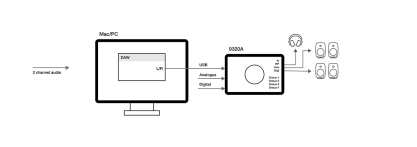
9320A « Prêt à l'emploi » – Configuration stéréo double de base
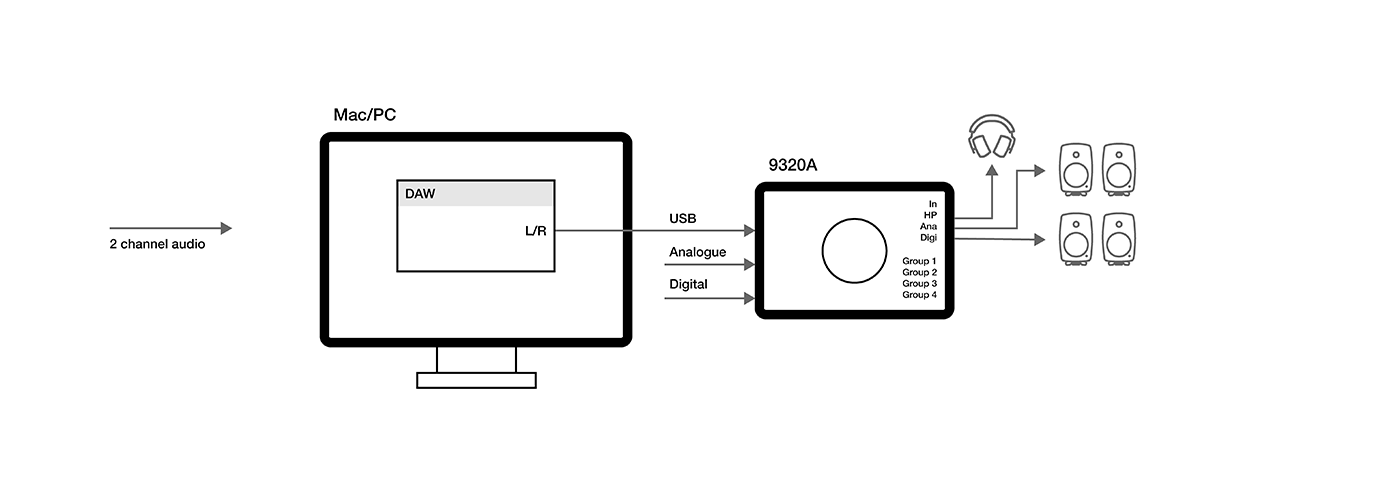
- Pas d'accès aux Group Presets.
- Pas de mode binaural.
- Fonctionne avec ou sans Mac ou PC.
- Groupes 1 à 4 inactifs.
- L'audio peut provenir du port USB de l'ordinateur ou d'une entrée analogique/numérique. La touche « Input » permet de sélectionner l'entrée.
- L'audio peut être routé vers n'importe quelle sortie : casque, analogique ou numérique.
- Le volume peut être réglé à l'aide de la molette.
- Les touches Mono, Diff, Invert, Mute, Dim et Preset sont opérationnelles.
- Le logiciel GLM est requis pour une utilisation avancée, par exemple pour aligner les niveaux de sortie, ainsi que pour contrôler et calibrer le système SAM.
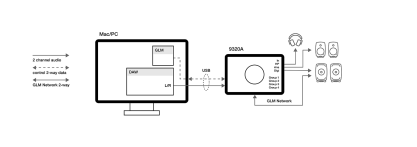
9320A avec GLM – GLM stéréo double
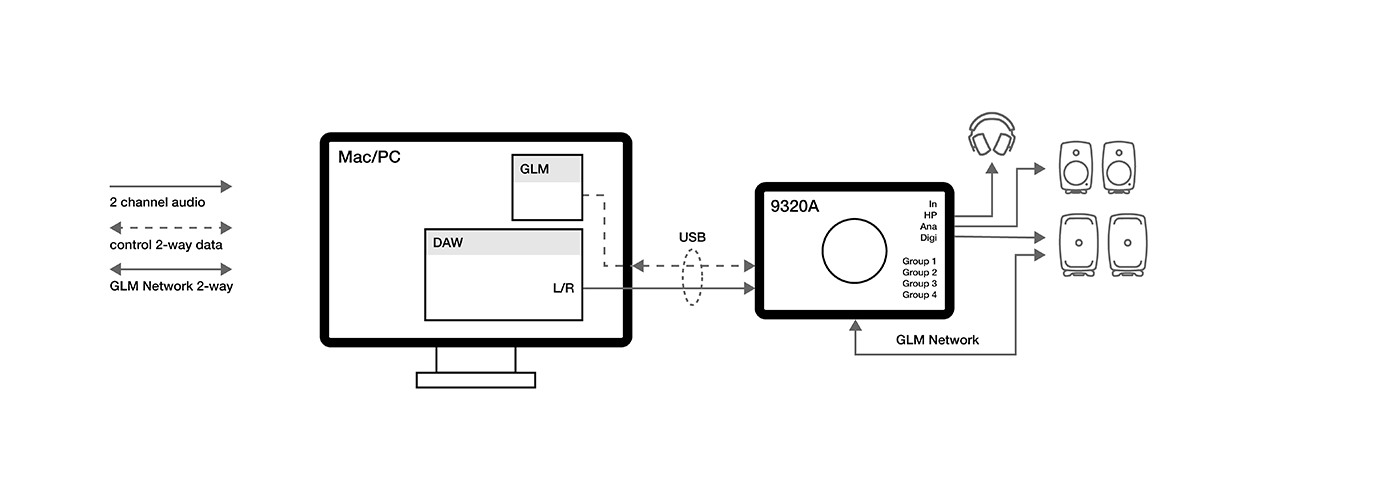
- Calibrage GLM et presets.
- Pas de mode binaural.
- Groupes 1 à 4 disponibles.
- Sortie numérique associée au GLM.
- Cliquez sur « Digi » pour utiliser le même preset.
- Cliquez sur les groupes 1 à 4 pour changer de groupe.
- L'audio peut provenir du port USB de l'ordinateur ou d'une entrée analogique/numérique. Le préréglage du groupe GLM permet de sélectionner une entrée ; par la suite, les boutons d'entrée peuvent être utilisés pour en changer.
- L'audio peut être routé vers n'importe quelle sortie : casque, analogique, numérique ou aucune. Le préréglage du groupe GLM définit la sortie lorsqu'un groupe est activé.
- Les enceintes SAM peuvent être calibrées à l'aide du 9320A et du logiciel GLM.
- Le volume peut être contrôlé via la molettede volume.
- Les fonctions Mono, Diff, Invert, Mute, Dim, Preset et les touches de groupe sont opérationnelles.

9320A avec GLM – Double stéréo / Casque immersif
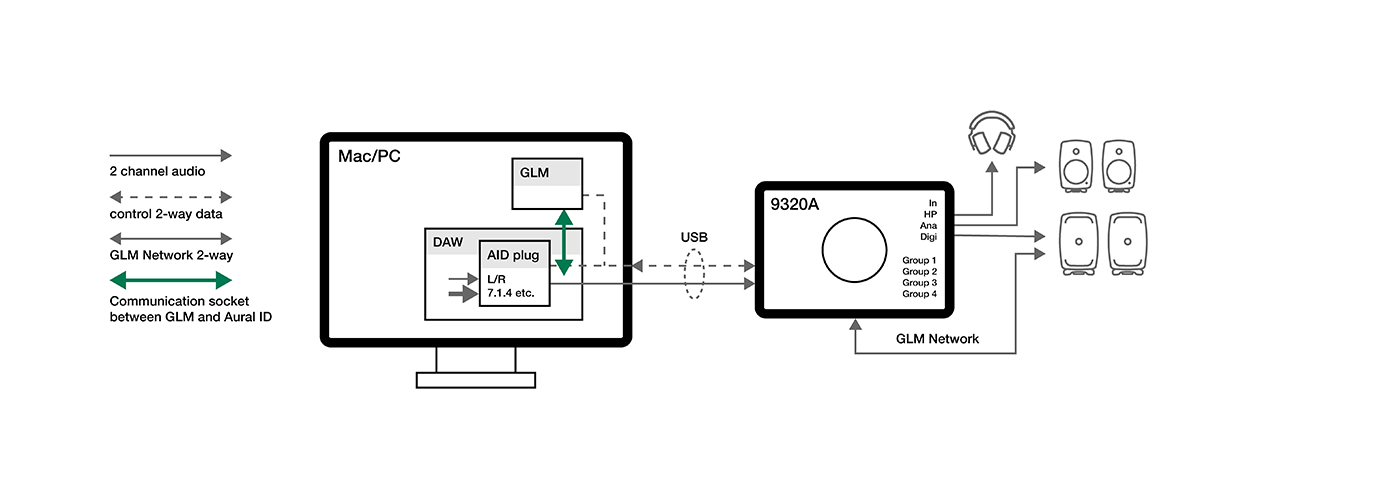
- Calibrage et presetsGLM.
- Aural ID stéréo.
- Aural ID immersif.
- Groupes 1 à 4 disponibles.
- Sortie numérique associée au GLM.
- Cliquez sur « Digi » pour utiliser le même preset.
- Cliquez sur les groupes 1 à 4 pour changer de groupe.
- USB stéréo ou binaural, selon la sélection de sortie du 9320A.
- Le plug-in Aural ID passe en mode bypass L/R (contrôlé via USB) lorsque l'audio binaural n'est pas utilisé.
- Lors de l'utilisation des traitements GLM et Aural ID, le GLM désactive le traitement si l'écoute en salle (in-room monitoring) est activée.

9320A Double stéréo Immersif en salle /Plug in casque Immersif
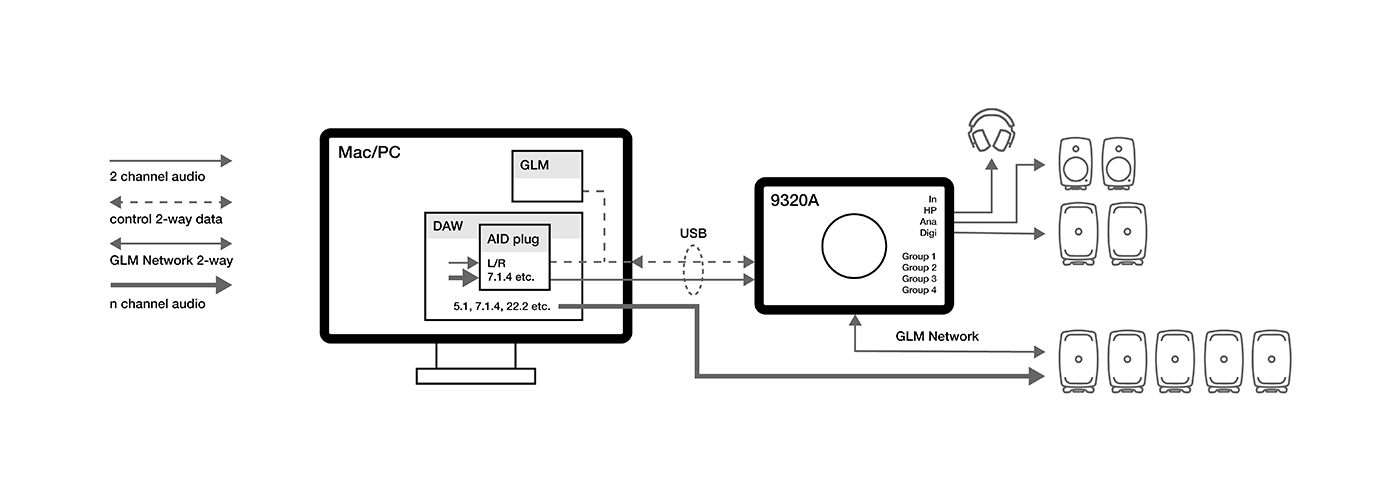
- Calibrage et presets GLM.
- Aural ID stéréo (plug-in).
- Aural ID immersif (plug-in).
- Système immersif en salle.
- Les groupes 1 à 4 sélectionnent le grand système en salle.
- Sortie numérique non associée au GLM.
- USB stéréo ou binaural, selon la sélection de sortie du 9320A.

9320A Aural ID autonome + moniteurs SAM immersifs
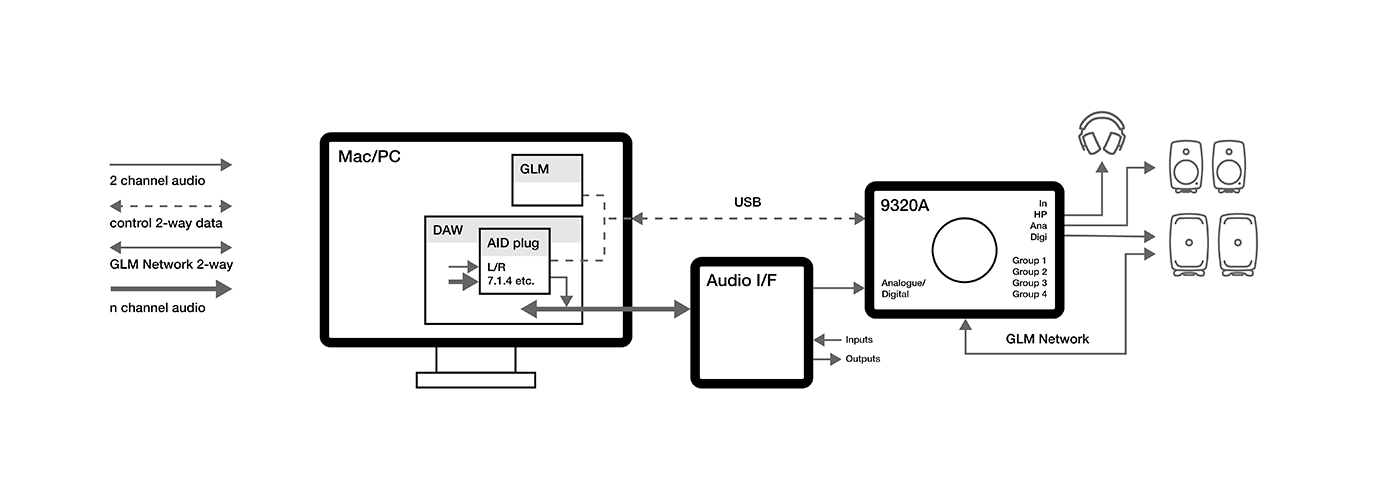
- Calibrage et presets GLM.
- Aural ID stéréo.
- Aural ID immersif.
- Groupes 1 à 4 disponibles.
- Sortie numérique associée à GLM.
- Cliquez sur « Digi » pour utiliser le même préréglage.
- Cliquez sur les groupes 1 à 4 pour changer de groupe.
- Le plug-in/l'application Aural ID transmet les signaux L/R et est contrôlé(e) via USB lorsque l'audio binaural n'est pas utilisé.
9320A Double stéréo immersif en salle / App casque immersif
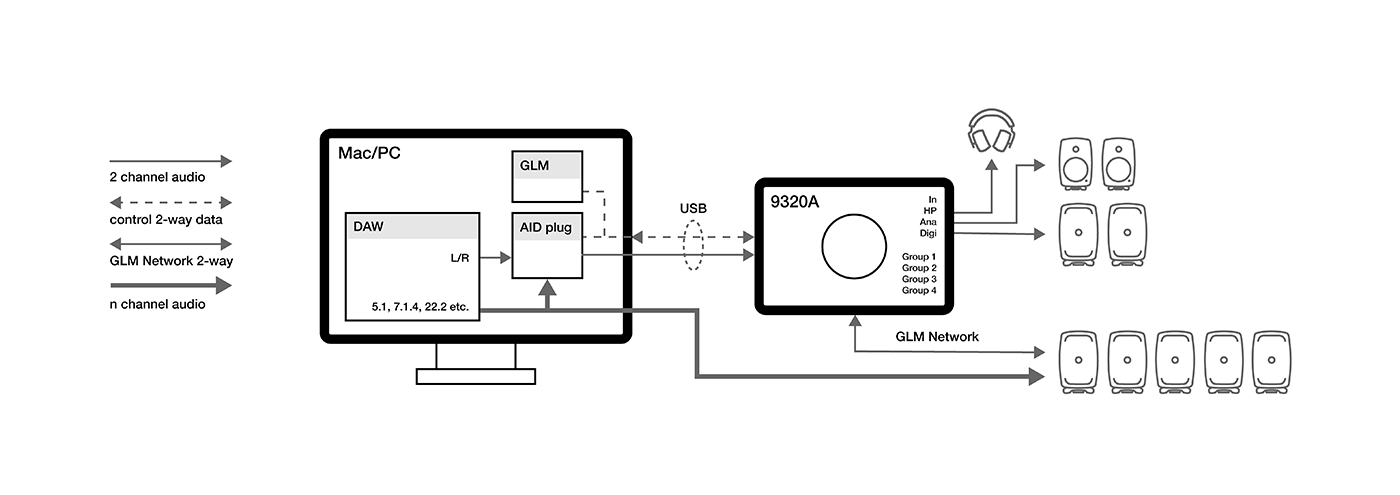
- Calibrage et presets GLM.
- Aural ID stéréo (application).
- Aural ID immersif (application).
- Les groupes 1 à 4 sélectionnent le système principal de la pièce.
- Sortie numérique non associée au GLM.
- USB stéréo ou binaural, selon la sélection de sortie du 9320A.
Genelec
UNIO Personal Reference Monitoring


Genelec
UNIO Personal Reference Monitoring
Monitoring de Référence Personnel
Récompenses



Spécifications techniques


Dimensions
Height: 60 mm (2.4 inches)
Width: 190 mm (7.5 inches)
Length: 139 mm (5.5 inches)
Weight: 0.9 kg (2.0 lb)
D'autres détails techniques concernant le 9320A et notre solution de monitoring de référence personnel suivront dans les prochains jours.

Trouver un revendeur
 Filtres

Documentation


9320A
SAM™ Reference Controller
Technical Specifications
9320A
SAM™ Reference Controller
Technical Specifications
Connectivity
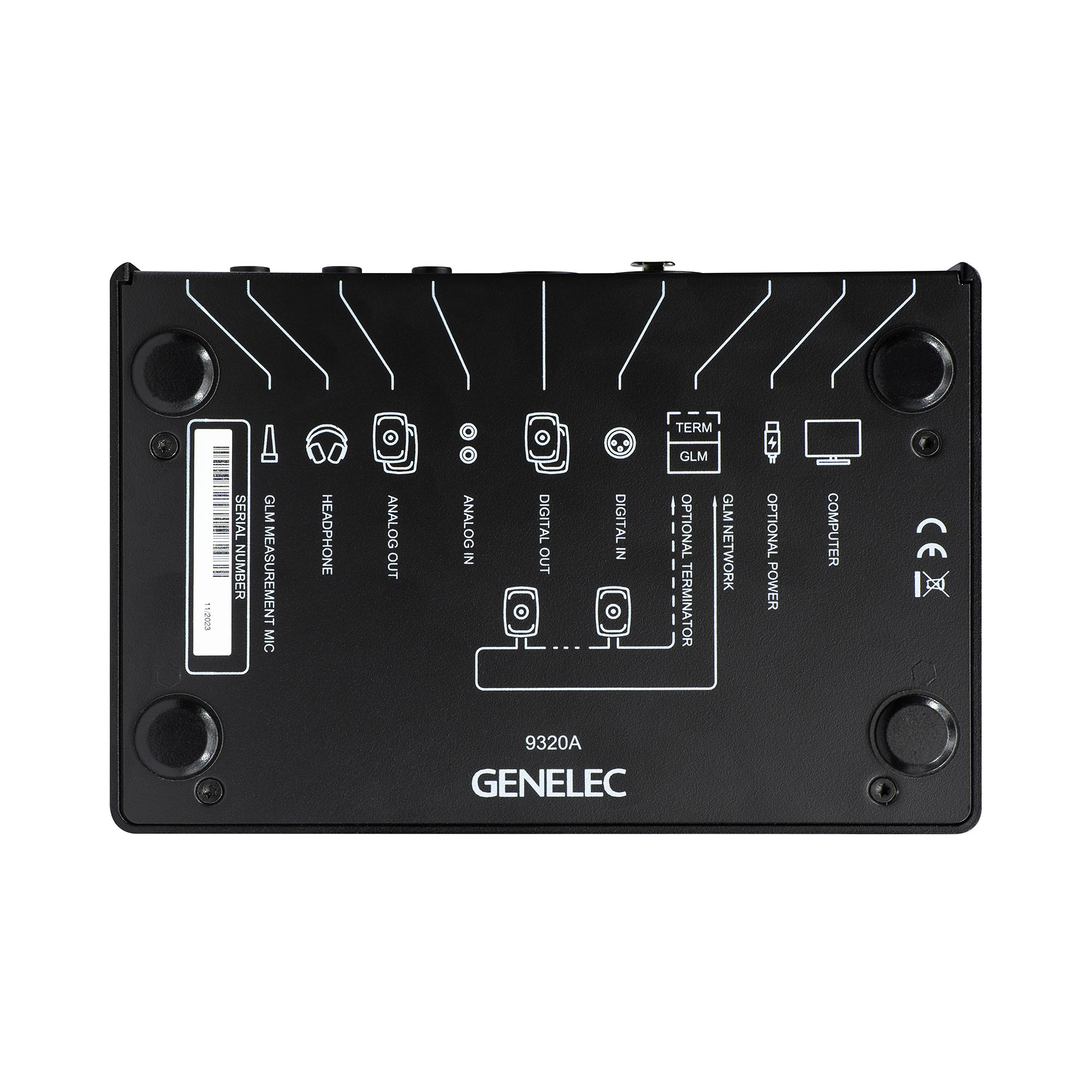
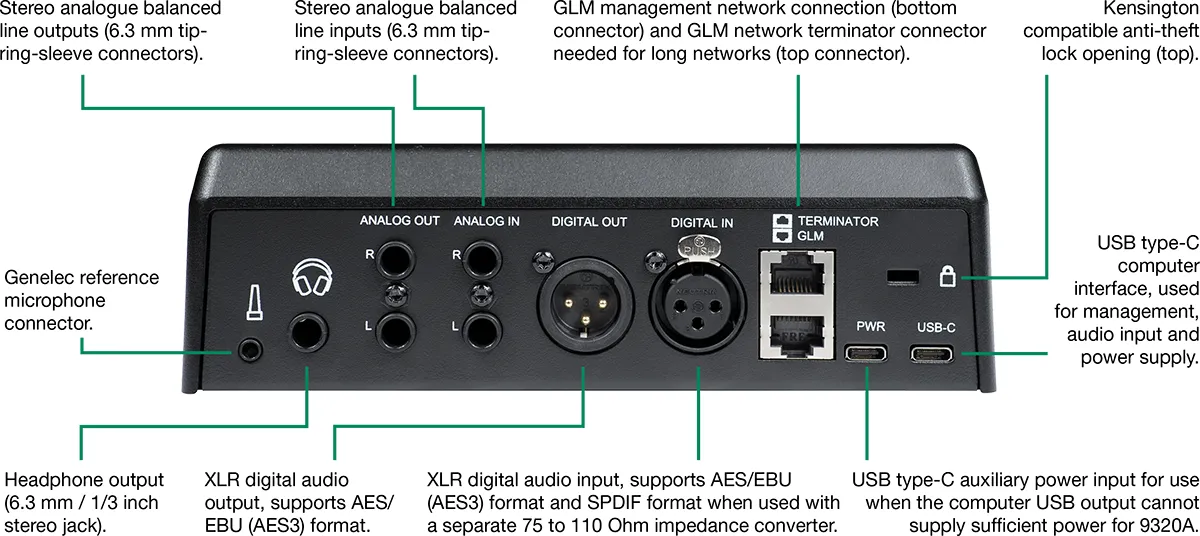
• Genelec measurement microphone connector.
• Headphones output (6.3 mm stereo jack).
• Stereo analogue balanced line outputs (6.3 mm tip-ring-sleeve connectors).
• Stereo analogue balanced line inputs (6.3 mm tip-ring-sleeve connectors).
• XLR digital audio output, supports AES/EBU (AES3) format.
• XLR digital audio input, supports AES/EBU (AES3) format and SPDIF format when used with a separate 75 to 110 ohm impedance converter.
• GLM management network connection (bottom connector) and GLM network terminator connector needed for long networks (top connector).
• USB type C auxiliary power input for use when the computer USB output cannot supply sufficient power for 9320A.
• Kensington compatible anti-theft lock opening (top).
• USB type C computer interface, used for management, audio input, and power supply for 9320A.
Performance Summary
| Headphone output load condition | Headphone impedance (Ω) | Max output power (mW) |
|---|---|---|
| Max output power into two simultaneous output channels, both channels loaded | 16 | 120 |
| 32 | 140 | |
| 150 | 200 | |
| 300 | 115 | |
| 600 | 57 |
Noise dose calculation standards available in 9320A
| Name | US OSHA/MSHA | US NIOSH/ACGIH | US DOD 3dB | US DOD 4dB | Europe EU-OSHA | Explanation |
|---|---|---|---|---|---|---|
| Lcrit | 90 | 85 | 85 | 85 | 85 | Noise dose safety limit (dB) |
| Tcrit | 8 | 8 | 8 | 8 | 8 | Duration of accumulation (h) |
| rate | 5 | 3 | 3 | 4 | 3 | Exchange rate (dB) |
9320A
SAM™ Reference Controller
Technical Specifications
9320A
SAM™ Reference Controller
Technical Specifications
Connectivity
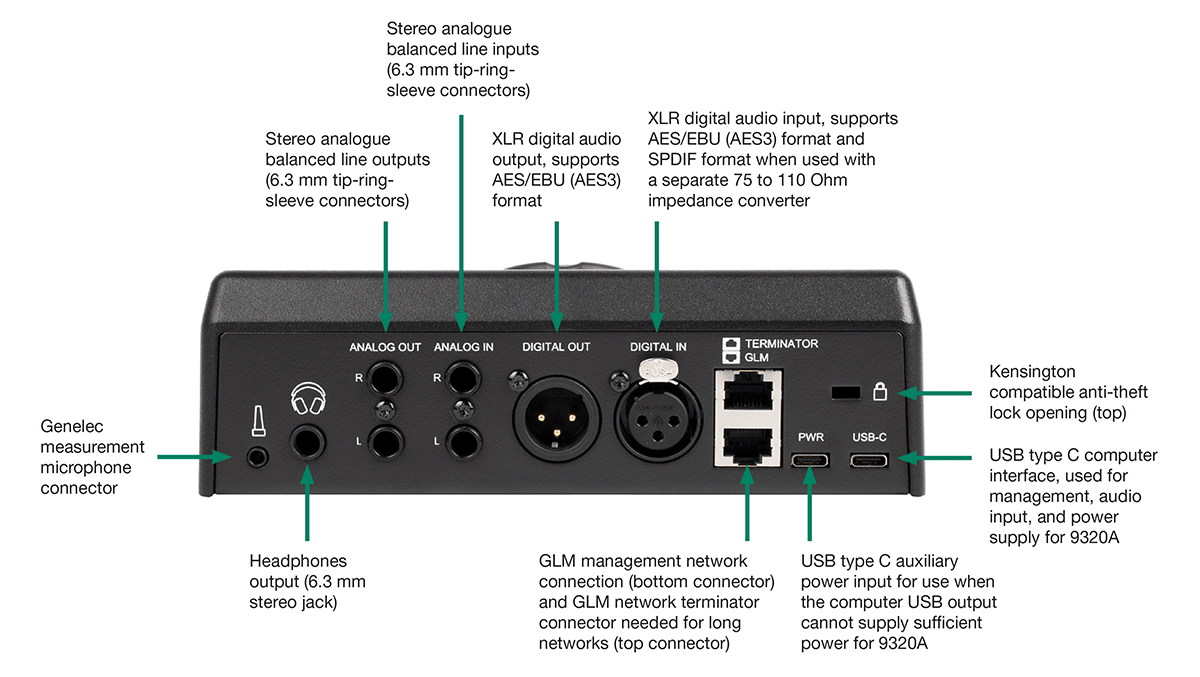
• Genelec measurement microphone connector.
• Headphones output (6.3 mm stereo jack).
• Stereo analogue balanced line outputs (6.3 mm tip-ring-sleeve connectors).
• Stereo analogue balanced line inputs (6.3 mm tip-ring-sleeve connectors).
• XLR digital audio output, supports AES/EBU (AES3) format.
• XLR digital audio input, supports AES/EBU (AES3) format and SPDIF format when used with a separate 75 to 110 ohm impedance converter.
• GLM management network connection (bottom connector) and GLM network terminator connector needed for long networks (top connector).
• USB type C auxiliary power input for use when the computer USB output cannot supply sufficient power for 9320A.
• Kensington compatible anti-theft lock opening (top).
• USB type C computer interface, used for management, audio input, and power supply for 9320A.
The 9320 uses power from one USB connector at a time. When both connectors are connected, the PWR connector is used for power. The computer USB-C power input limits to 2.5 W input power (500mA input current). When the PWR connector is in used, the output power available to the headphone is
slightly higher; the benefit is +0 dB to 2.5 dB more output, depending on the load impedance. The PWR input connector is designed to work with a standard 5 V 1A USB power adapter.
Performance Summary
Mechanical and power
| Parameter | Unit | Value |
|---|---|---|
| Weight | kg (lbs) | 0.890 (2.0) |
| Height | mm (in) | 60 (2 3/8) |
| Width | mm (in) | 190 (7 1/2) |
| Depth | mm (in) | 139 (5 1/2) |
| Supply voltage, USB type C connector | VDC | 5 |
| Operating power consumption, no outputs driven | W | 1.5 |
| Operating power consumption, using computer connector USB-C | W | < 2.5 (typ. 2.25) |
| Operating power consumption, using PWR connector USB-C | W | < 3.5 |
| Sleep mode power consumption | W | 0.125 |
| Operating temperature | C (F) | 15 – 35 (60 – 95) |
| Operating humidity, noncondensing | % | 10 – 80 |
Typical system performance
| Parameter | Unit | AES/EBU input to headphone output | AES/EBU input to line output | Line input to line output | Line input to headphone output | Line input to AES/EBU output |
|---|---|---|---|---|---|---|
| Frequency response, – 3 dB point | kHz | 0 – 46 | 0 – 46 | 0.2 Hz – 46 | 0.2 Hz – 46 | 0.2 Hz – 46 |
| Frequency response flatness, measurement range 10Hz – 40 kHz | dB | ± 0.1 | ± 0.1 | ± 0.1 | ± 0.1 | ± 0.1 |
| Channel gain difference | dB | < 0.1 | < 0.1 | < 0.1 | < 0.1 | < 0.1 |
| Dynamic range (Lo Gain / Hi Gain) | dB | 126 (250-600Ω) | 126 | 121 / 118 | 121 / 118 | 123 / 121 |
| Noise (A weighted), measurement range 20 Hz – 20 kHz, (Vol. -0dBFS) (Lo Gain / Hi Gain) | μV | 3 / 3 | 5.5 / 7.5 | 5.5 / 7.5 | n.a. | n.a. |
| THD+N distortion and noise (Lo Gain), maximum volume setting, input signal -6 to 0 dBFS 1 kHz, measurement range 20 Hz - 20 kHz | % / dB | < 0.0004 / < –108 | < 0.0004 / < –108 | < 0.0005 / < –106 | < 0.0005 / < –106 | < 0.0004 / < –108 |
| THD+N distortion and noise (Hi Gain), maximum volume setting, input signal -6 to 0 dBFS 1 kHz, measurement range 20 Hz - 20 kHz | % / dB | n.a. | n.a. | < 0.0006 / -104 | < 0.0006 / -104 | < 0.0005 / -106 |
| Input to output latency | ms | 3.2 | 3.2 | 2.1 | 2.1 | 2.0 |
| Crosstalk 10kHz -10dBFS Load impedances (100 kΩ, 150 Ω, 32 Ω)* | dB | -120, -87, -74* | -120 | -120 | -120, -87, -74* | -120 |
| * When using small headphone loads, most of the crosstalk is caused by impedance of common ground of TRS connector. | ||||||
Typical output performance
| Parameter | Unit | Headphone output | Analog line output | AES/EBU output |
|---|---|---|---|---|
| Connector | 1/4 in TRS | 1/4 in TRS | XLR male | |
| Electrical interface | Split supply, ground referenced | Balanced | AES 3 | |
| Maximum output voltage | V RMS (dBu) | 6 (17.8) | 6 (17.8) | n.a. |
| V peak | 10.6 | 10.6 | n.a. | |
| V peak-to-peak | 21.3 | 21.3 | n.a. | |
| Output impedance | Ω (ohm) | 1.5 | 80 | 110 |
| Max output current | mA | 120 | n.a. | n.a. |
| Headphone maximum output power (Both left and right channels loaded. Power feed from the computer USB-C connector. In parenthesis when the PWR USB-C input is used for power.) | mW |
|
n.a. | n.a. |
| Frequency response (-3 dB point) | kHz | 0 – 46 | 0 – 46 | 0 – 46 |
| Frequency response flatness (range 10Hz – 40 kHz) | dB | ± 0.1 | ± 0.1 | ± 0.01 |
| Channel gain difference | dB | < 0.05 | < 0.05 | < 0.01 |
| Dynamic range | dB | 126 (Load 250-600Ω) | 126 | 138 |
| Noise A weighted (20-20 kHz) | uV | 3 | 3 | n.a. |
| Distortion and noise (250-600Ω) Input -6 to 0 dBFS 1 kHz, 20 Hz to 20 kHz measurement range. | % | < 0.0004 | < 0.0004 | n.a. |
| dB | < –108 | < –108 | n.a. |
Typical input performance
| Parameter | Unit | Analogue line input | USB input | AES/EBU input |
|---|---|---|---|---|
| Connector | mm (in) | 6.3 (1/4) TRS | USB-C | XLR female |
| Interface type, electrical | Balanced | USB 2.0 High Speed | AES 3 | |
| Maximum input voltage (Lo Gain) | dBu | 24 | n.a. | n.a. |
| Maximum input voltage (Hi Gain) | dBu | 12 | n.a. | n.a. |
| Input impedance, differential | Ω (ohm) | 6600 | n.a. | 110 |
| Frequency response, -3 dB | kHz | 0.2 Hz - 46 | 0 – 46 | 0 – 46 |
| Samplerates | kHz | n.a. | 44.1, 48, 88.2, 96, 176.4, 192 | 32 – 192 |
| Sample word length | bit | n.a. | 24 | 16 – 24 |
| Frequency response flatness 20 Hz - 40 kHz | dB | ± 0.05 | ± 0.01 | ± 0.01 |
| Channel gain difference | dB | < 0.05 | < 0.01 | < 0.01 |
| Dynamic range (A weighted) 20-20kHz (Lo Gain / Hi Gain) | dB | 123 / 121 | 138 (24 bit) | 138 (24 bit) |
| Equivalent input noise (A weighted) 20-20kHz (Lo Gain / Hi Gain) | μV | 9 / 3 | n.a. | n.a. |
| THD+N distortion and noise (Hi Gain), input signal -6 to 0 dBFS 1 kHz, measurement range 20 Hz - 20 kHz | % / dB | 0.0005 / –106 | n.a. | n.a. |
| Distortion and noise (Low Gain), input signal -6 to 0 dBFS 1 kHz, measurement range 20 Hz - 20 kHz | % / dB | 0.0004 / –108 | n.a. | n.a. |

Typical total harmonic distortion + noise performance of the headphone output at various headphone imedances.